
The Best AI Tools for SCADA Programming: What is Available in 2026?

Supervisory Control and Data Acquisition (SCADA) engineers are increasingly tasked with bridging the gap between traditional control systems and modern IT networks. In practice, this often involves interpreting outdated, undocumented PLC code and connecting legacy hardware to modern cloud architectures, enterprise databases, and web-based Human Machine Interface (HMI).
Intelligent automation tools are becoming essential to help engineers rapidly decipher complex logic routines, map thousands of tags, and accelerate debugging without manually parsing every line of code. While generic artificial intelligence has proven highly effective for standard IT scripting, it has inherent limitations when applied directly to Operational Technology (OT).
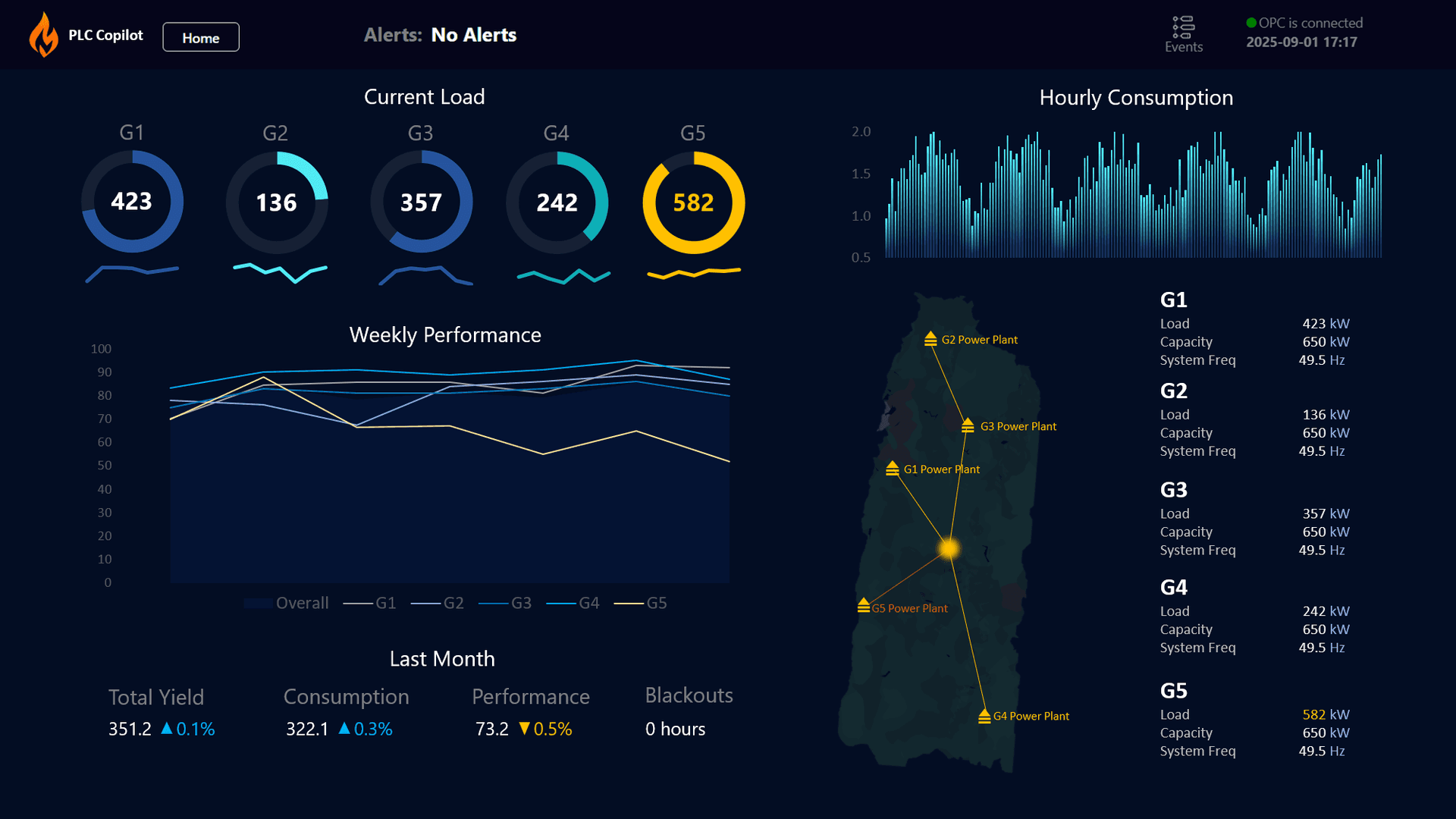
In this article, we reviewed the limits of general-purpose AI, the latest 2026 integration trends from major vendors like Ignition, AVEVA, Siemens, and Beckhoff, and why PLC Copilot has emerged as a premier solution for SCADA engineers.
The SCADA Engineer Role is Expanding
SCADA engineers are no longer just building simple HMI screens; they are managing complex IT/OT convergences. With the rise of industrial edge computing and enterprise data integration, their daily responsibilities have expanded to include database management, networking, cloud synchronization, and IIoT architecture. Crucially, this modern scope usually sits on top of legacy infrastructure, forcing engineers to interpret PLC logic while connecting field hardware to modern software stacks.
This expanded workload makes adopting intelligent automation tools essential for maintaining operational efficiency and plant safety. By leveraging AI to parse complex logic routines and handle repetitive data tasks, engineers can drastically reduce troubleshooting time while building higher-quality, more secure industrial control systems.
Generic AI
What Can Generic AI Do for Industrial Automation?
Generic AI models, such as ChatGPT, are built primarily for conversational fluency and general tasks rather than the deterministic logic required for industrial automation. These platforms are trained on vast datasets from the public internet, making them exceptionally proficient in IT programming languages like Python and JavaScript, as well as general engineering concepts. However, most SCADA programs run on proprietary languages that was never exposed on the internet. Naturally they can't understand or interact with them.
Because of this broad background, generic AI serves as an excellent tool for beginner training, helping junior engineers understand basic syntax, learn standard control concepts, or draft high-level documentation. However, these general models have no context regarding your specific facility.
They also lack access to the context of your SCADA project, internal memory structures, and hardware tag databases. Without this localized project context, you'll need to manually copy and paste bits and pieces of your project to the chat, and that may lead to convincing yet inaccurate outputs, commonly referred to as AI hallucinations, which can pose significant operational risks on the plant floor.

Claude for SCADA: General Purpose AI Agents
While a generic AI chatbot simply responds to text prompts in a browser window, an AI agent can actively explore your local file system, run terminal commands, and execute multi-step coding workflows autonomously. Modern coding agents like Claude Code and Cursor are incredibly powerful for traditional software development because they can read your entire project repository to gain context before writing a solution.
These general-purpose AI agents are highly useful for writing supplementary IT scripts, such as Jython snippets for Ignition or querying SQL databases for web tools. They can easily help build internal applications or external dashboards that connect to SCADA systems via standard APIs.
However, they hit a hard wall when it comes to actual operational technology (OT). While they can read standard text-based IT files, the vast majority of proprietary SCADA and PLC project files are compiled binaries or undocumented export formats that are completely unreadable to them. Because they cannot parse these proprietary file structures natively, they cannot build an end-to-end SCADA program, interact with HMI graphical interfaces, or safely generate deterministic PLC code.
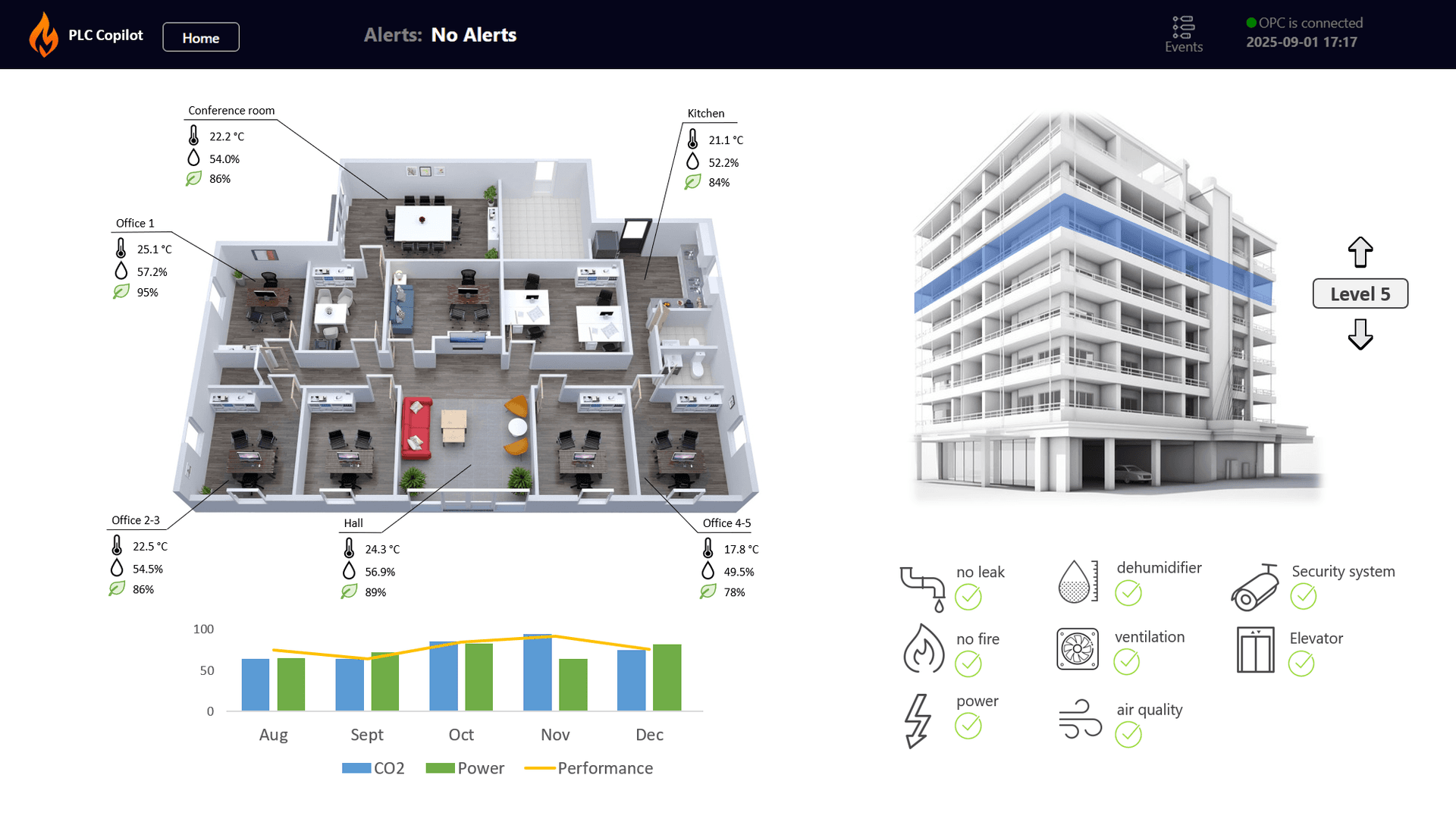
The Latest AI Trends in the Automation Industry
The automation industry is shifting away from generic LLMs toward purpose-built AI integrations embedded directly into the engineering environment. Major vendors are now releasing native APIs and AI assistants designed specifically to handle industrial data structures. This trend bridges the gap between IT-style generative AI and the strict safety requirements of Operational Technology (OT).
AI tools: Ignition
Ignition by Inductive Automation leverages an open ecosystem approach, allowing AI integration through scripting, third-party ML modules, and edge computing. Recent developments include the Model Context Protocol (MCP), which securely connects generative AI assistants directly to Ignition's runtime. This allows AI to intelligently interact with tag historians and data tables without disrupting the core SCADA application.
AI tools: AVEVA
AVEVA facilitates AI connectivity through its AVEVA CONNECT platform and its Integration Studio, providing secure cloud-hosted environments for digital twins and predictive modeling. AI integrations typically rely on the AVEVA PI System, feeding real-time, time-series data from sensors into advanced analytics tools.
AI tools: Siemens WinCC
Siemens integrates AI into WinCC Unified and TIA Portal using their Model Context Protocol (MCP) server and the TIA Portal Openness API. This allows generative AI agents to translate natural language prompts into API calls that read real-time tags, historical data, and alarms.
AI tools: Beckhoff TwinCAT
Beckhoff integrates AI directly into the deterministic real-time controller using the TwinCAT 3 Machine Learning environment, requiring no external hardware. Instead of relying on cloud connectivity that can introduce latency or security risks, trained models are executed natively within the TwinCAT eXtended Automation Runtime (XAR) in strict synchronization with the standard machine control logic.
How PLC Copilot can help SCADA Engineers?
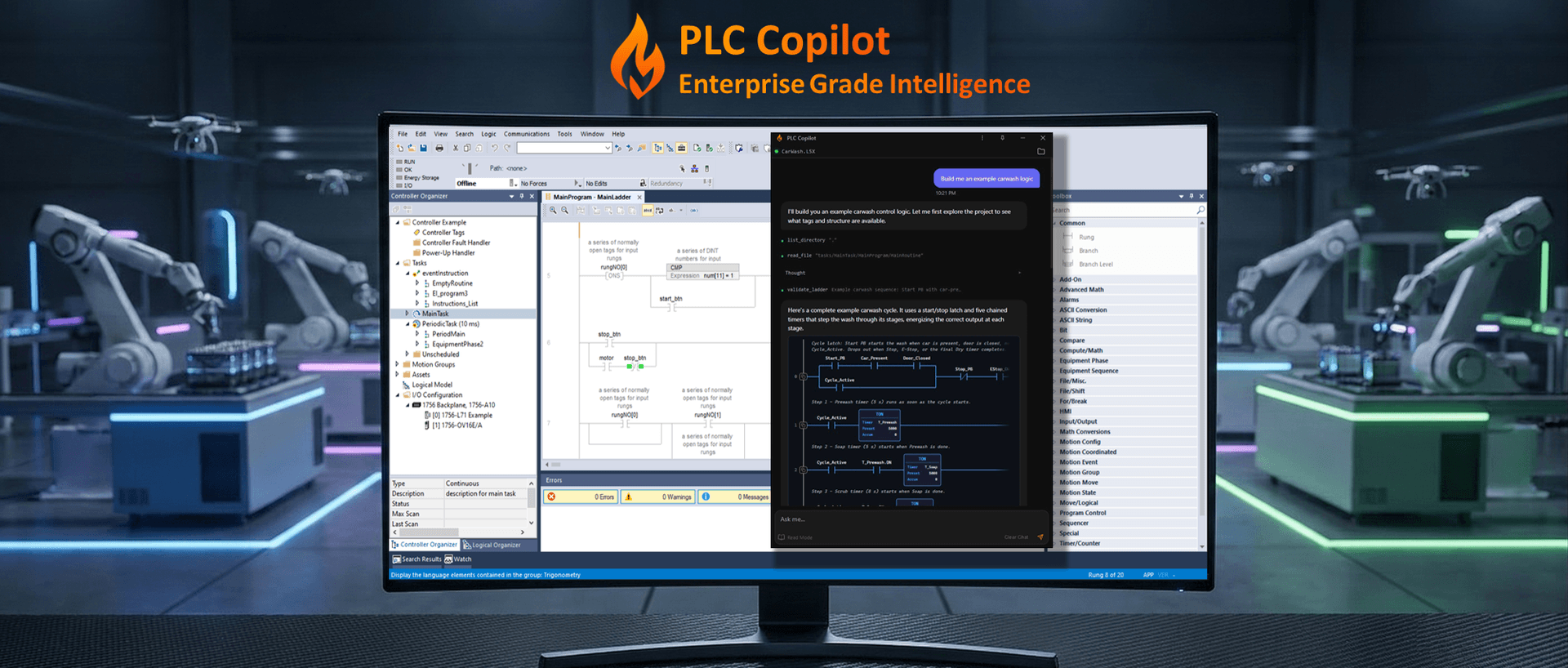
PLC Copilot is a purpose-built desktop application designed explicitly for the operational technology (OT) environment. Unlike web-based chatbots, it loads your proprietary PLC project files locally to provide deep, contextual assistance without compromising data sovereignty. It acts as an intelligent companion that understands the complex relationships between your controller logic and SCADA program.
AI Can Decipher the PLC Code
PLC Copilot is a desktop application that locally browses your controller tree, routines, and memory mapping to answer your questions in plain language. By analyzing your PLC Code, the AI can explain undocumented legacy "spaghetti" code step-by-step or point you to the exact rung causing an issue. This capability turns thousands of lines of confusing Structured Text or Ladder Logic into clear, readable summaries for SCADA engineers.
PLC Copilot Cross-References Tags and I/O Lists Instantly
The software can load multiple project files simultaneously, giving the agent full context to trace alias tags across multiple routines and PLCs. Instead of manually searching through massive spreadsheets, engineers can instantly cross-reference I/O lists with the corresponding SCADA tags. This eliminates the tedious copy-paste errors that frequently occur when mapping field devices to HMI screens.
PLC Copilot Connects HMI Alarms Directly to the Root Cause
Because PLC Copilot understands the entire PLC logic, it bridges the gap between the SCADA interface and the controller's raw code. When an obscure HMI alarm triggers, the AI can trace the tag back through the interlocking logic to identify the exact physical sensor causing the fault. This drastically reduces troubleshooting time during plant floor emergencies.
Vendor-Agnostic and Secure for Air-Gapped Networks
Industrial plants rarely rely on a single brand of hardware, which is why PLC Copilot is designed to be completely vendor-agnostic. It natively supports major platforms like Siemens, Rockwell, and AutomationDirect controllers all within the same workspace. This cross-platform compatibility makes it an incredibly powerful tool when reverse-engineering or upgrading an old, undocumented legacy machine into a modern SCADA template.
Furthermore, because industrial data sovereignty is critical, PLC Copilot is built from the ground up to keep your proprietary intellectual property safe. Engineers can run the service securely out of the box or connect it to their company's own on-premise AI models. For highly sensitive facilities, it offers local, fully air-gapped deployment options. This ensures that your plant layouts, I/O lists, and logic sequences remain 100% behind the corporate firewall.
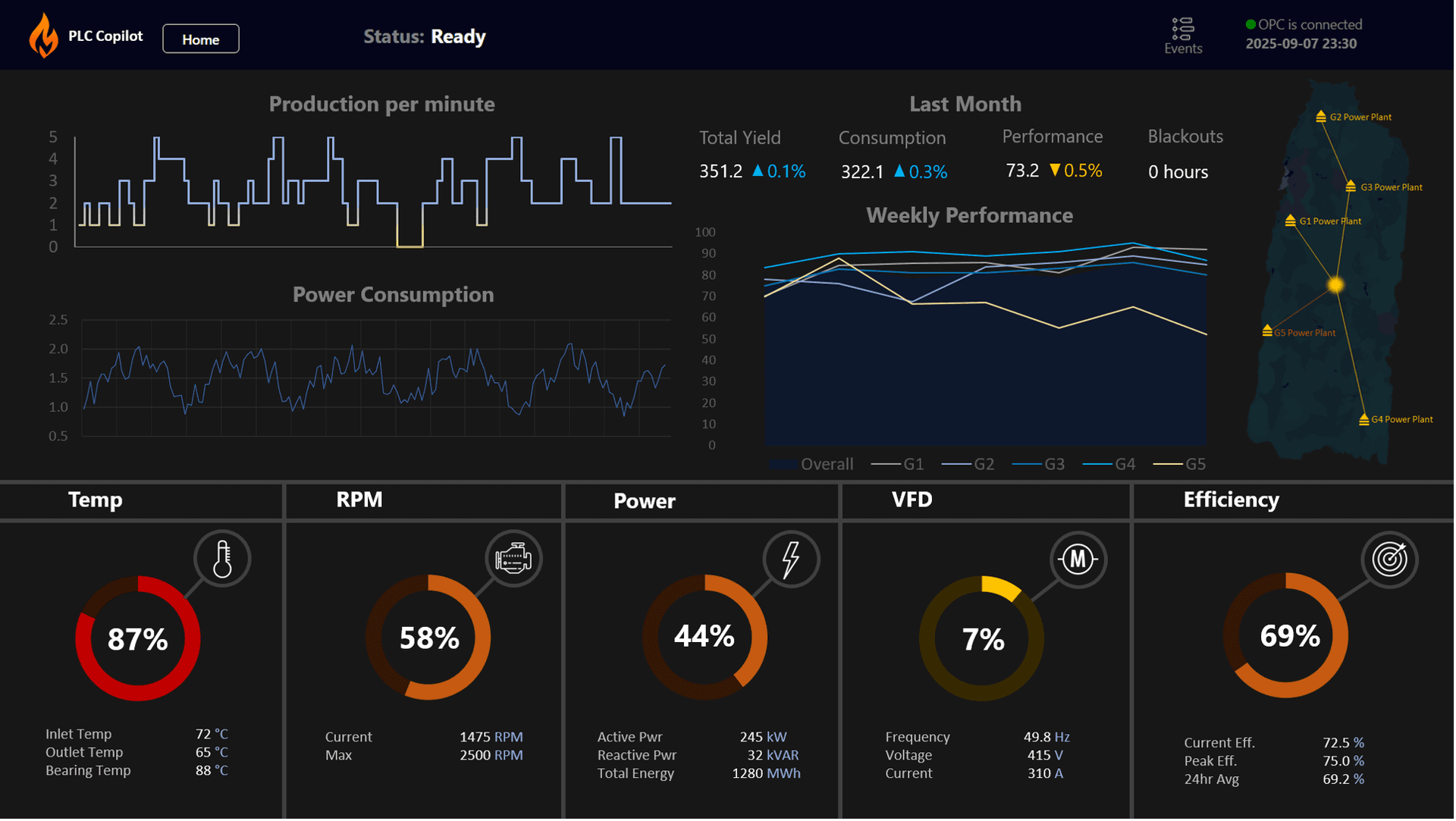
What Are the Core Capabilities Needed in an AI for SCADA Systems?
1. Validated and Correct Responses
Unlike general-purpose models that prioritize conversational fluency, an industrial AI must produce syntactically verifiable and logically sound outputs. It should validate every routine against target compiler rules and vendor-specific constraints to ensure suggestions execute safely on the plant floor.
2. Security and Privacy
A viable industrial AI must adhere to strict data sovereignty standards by offering local processing, on-premise hosting, or fully air-gapped deployment options. This guarantees that proprietary control logic remains behind the corporate firewall and is never used to train public models.
3. Guardrails
Industrial AI platforms require built-in safety guardrails to prevent dangerous hallucinations or invalid state transitions from entering the control logic. These guardrails enforce safe engineering limits, flag potential interlock conflicts, and verify syntax against established safety protocols before code reaches a developer. By serving as an automated sanity check, guardrails ensure that AI suggestions never compromise operational safety.
4. Context Awareness
An effective SCADA assistant must look beyond isolated code blocks and comprehend the entire system architecture, including memory maps, alias tags, and multi-controller networks. Context awareness enables the AI to trace a signal from field I/O devices, through complex PLC routines, and directly up to the HMI alarm banner. Without this holistic project context, an AI cannot accurately identify root causes or cross-reference dependencies across different plant areas.
5. Domain Knowledge
General AI platforms lack specialized comprehension of both software standards—like IEC 61131-3 languages (LAD, ST, FBD) and physical hardware nuances, such as I/O module mapping, scan times, and fieldbus protocols like EtherNet/IP or PROFINET. Purpose-built industrial AI is trained natively on vendor instruction sets, hardware topologies, and SCADA design patterns alongside industry standards like ISA-18.2 for alarm management. This combined software and hardware domain knowledge allows the tool to interpret complex physical state machines, field interlocks, and hardware limits.
6. Advanced Features
To deliver practical value, an industrial AI must go beyond text generation and support active engineering workflows. Essential features include live tag monitoring via OPC UA, EthernetIP, or MQTT, automated SQL query generation for historian databases, and one-click generation of handoff documents. Combined with sandboxed code execution and mathematical parsing, these advanced capabilities bridge the gap between static code analysis and real-time operational optimization.
Conclusion:
As SCADA systems expand to handle enterprise data, cloud platforms, and IIoT architectures, industrial automation engineers face an unprecedented workload. While generic AI tools offer assistance with general IT scripting and conceptual learning, their inability to parse compiled binary files, understand proprietary hardware topologies, or guarantee accurate responses make them unsuitable for direct OT control.
The future of industrial engineering lies in purpose-built, context-aware AI tools. Solutions like PLC Copilot bridge the gap between complex control logic and SCADA visualization, enabling engineers to decipher legacy code, map field I/O tags instantly, and trace HMI alarms directly to physical root causes. By leveraging AI engineered specifically for operational technology, engineering teams can eliminate tedious manual debugging, maintain strict data sovereignty behind corporate firewalls, and focus on optimizing plant performance.
Frequently asked questions
Still comparing tools? Best AI agent for PLC programming lays out specialized agents vs raw ChatGPT on real IDE workflows.