
AI for PLC Programming: What's Actually Possible in 2026
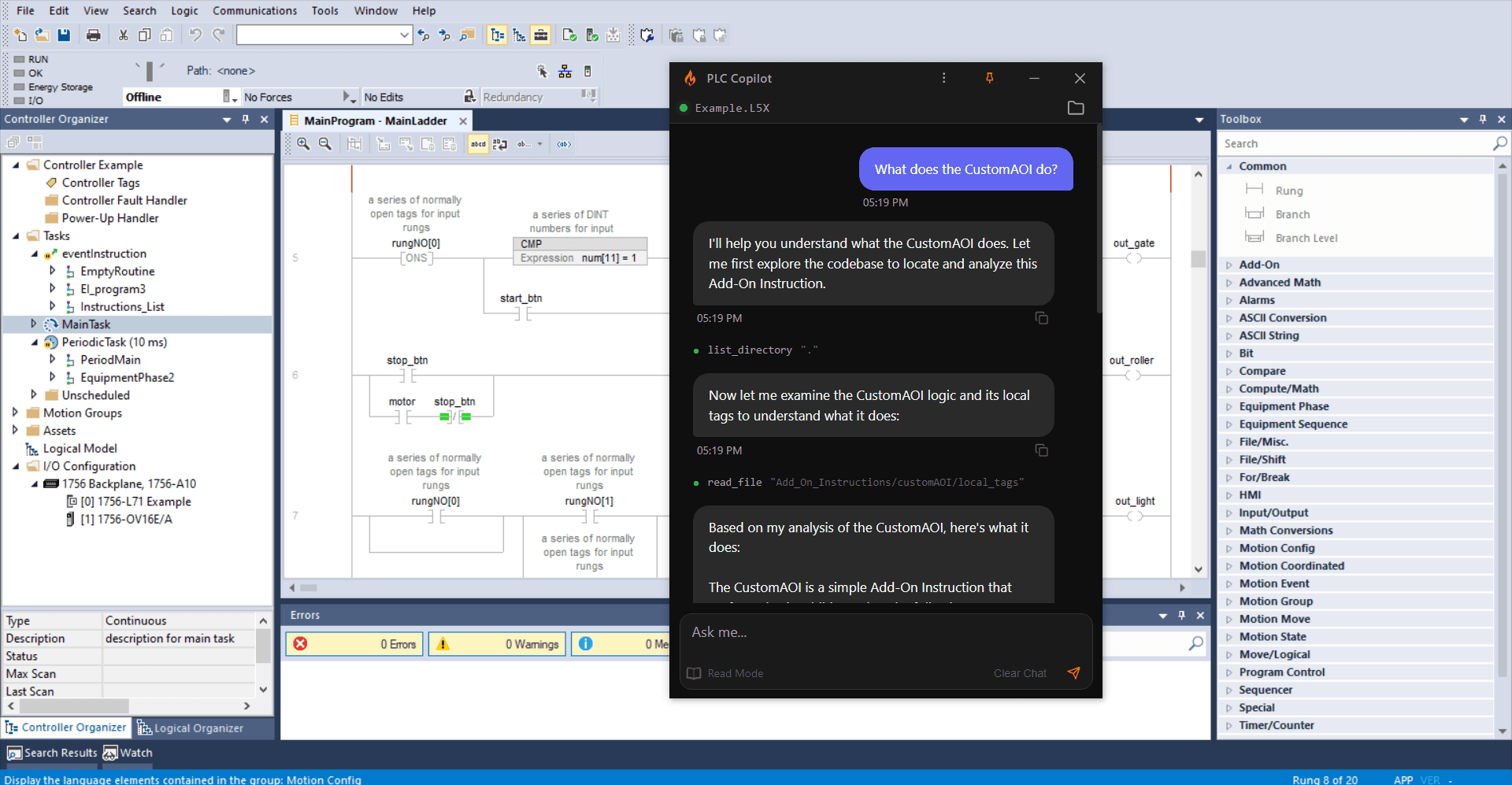

Where PLC Programming Stands in 2026
You've likely been there: staring at a sprawling page of ladder logic with 200 unreferenced tags, a deadline that was due yesterday, and a project manager asking why the conveyor sequence isn't finished yet. You're manually dragging contacts, double-checking coil addresses, and writing the same interlock logic for the tenth time this week. In these moments, the development environment can feel decades behind modern software tools.
In the midst of this repetitive syntax struggle, a practical question has started echoing through plant floors and engineering offices: Can AI for PLC programming actually help, or is it just another layer of hype in an industry that prizes reliability above all else?
For years, the promise of AI in industrial automation felt like a distant corporate slide deck. By 2026, however, the practical application has moved past simple proofs of concept. We aren't just talking about predictive maintenance anymore; we are seeing real-world use for AI for PLC code generation, automated documentation, and intelligent debugging. The real question for a controls engineer is where the marketing ends and the actual utility begins.
What AI Can Actually Do for PLC Programming Today
In 2026, the application of AI for PLC programming has moved beyond experimental chatbots to tools designed for the specific, deterministic requirements of the factory floor. While generic LLMs often struggle with the scan-based execution of a controller, purpose-built tools have bridged the technical gap.
If you are looking for the exact steps to implement this, check out our practical guide on the CAC framework for industrial prompting.
1. Ladder Logic Generation (Prompt-to-Rung)
One of the most practical developments is PLC ladder AI Agents that can convert plain-English process descriptions into functional rungs. Instead of building a standard motor control block from scratch with specialized fault latching and reset logic, an engineer can now provide a functional description:
"Generate a motor start/stop routine with a 5-second lubrication pre-start timer, a latching fault on the overload input, and a flashing pilot light output when in a fault state."
A specialized copilot PLC programming assistant doesn't just suggest generic code; it generates the specific contacts (XIC, XIO) and coils (OTE, OTL) required for your platform, organized into a logically sound sequence. This allows engineers to focus on the process flow rather than the repetitive syntax of the IDE.
2. Intelligent Code Review & Error Detection
AI for PLC tools can flag patterns a tired review pass might miss: dangling coils, timers with no reset, latch logic missing an unseal contact. What they catch vs miss, and how to validate before download, is covered in can AI generate PLC code without manual programming errors.
3. Automated Tag Naming & Site-Specific Documentation
Inheriting a project with tags like Tag_1 and Temp_Bit_99 is a familiar headache for most engineers. AI industrial automation tools can now analyze the logic flow and suggest descriptive, standardized tag names based on the context. If a bit is controlling the third valve on a manifold, the AI will suggest something accurate like VLV_Manifold_03_CMD.
Furthermore, AI PLC code generation handles the tedious task of rung commenting. By analyzing what the logic is doing, it can generate human-readable summaries that make future troubleshooting much faster.
4. Code Translation Between Dialects
As global supply chains shift, OEMs often need to port an Allen-Bradley Studio 5000 project to a Siemens TIA Portal environment or an AutomationDirect Productivity Suite project. AI tools can now assist with the bulk of the conversion between Structured Text (ST) and Ladder Diagram (LD) across different manufacturer dialects, respecting the unique instruction sets and memory mapping of each platform.
5. Explaining Legacy "Spaghetti" Code
Many of us have dealt with "black box" code, often thousands of lines of undocumented Structured Text written by someone who is no longer with the company. You can now feed these routines into a specialized PLC AI to get a clear, step-by-step explanation of the logic's intent. This is often an essential first step in a modernization project, allowing engineers to understand the system before they touch a single line of code.
What AI Still Can't Do (Yet)
While the progress is useful, it is important to address the limitations. Using AI for PLC programming requires a nuanced understanding of where the code ends and the physical machine begins. Reliability in industrial automation is non-negotiable, and treating AI as an "autopilot" is a serious safety risk.
It Doesn't Understand the Physical World
An AI knows that a High_Pressure_Switch should probably stop a Pump_Motor. It does not know that on a specific machine, the pressure switch might be located six feet away from the valve and has a mechanical lag that needs to be compensated for in software. AI lacks domain knowledge of the physical machinery, such as the weight of the rollers, the tension of the belts, or environmental noise on an analog signal.
It Doesn't Know Your Site Standards
Every plant has its own way of doing things which is needed to be explained to the AI, such as specific memory maps, naming conventions for different production lines, or preferred ways to handle HMI handshaking. Unless the AI is integrated into your specific project context, it will generate generic code that might not pass a corporate code review.
[!IMPORTANT] Safety Disclaimer: No AI-generated code should ever be deployed to a production environment without a thorough review and validation by a qualified Controls Engineer. AI serves best as an assistant, not a replacement for engineering judgment. For validation workflows and common error patterns, see can AI generate PLC code without manual programming errors.
Not All AI Tools Are Built for the Factory Floor
Browser chatbots and purpose-built PLC assistants solve different jobs. For a side-by-side comparison of general agents vs specialized tools, see which AI agent is best for PLC programming.
Real-World Ways Engineers Are Using AI for PLC Work Right Now
Scenario 1: New Project Bootstrapping
A lead engineer at a system integrator receives a functional specification for a new water treatment plant. Instead of spending days setting up the basic tag database and pump-alternation logic, they use an AI PLC code generation tool to generate the skeleton of the program. This saves hours of manual entry and allows them to transition straight to the core logic.
Scenario 2: Legacy Code Modernization
An OEM is replacing an old SLC 500 with a modern Productivity3000. The original code has no comments and complex addressing. The engineer feeds the old logic into the AI, which generates a technical brief of how the original sequence worked. This allows the engineer to rewrite the logic in the new platform with confidence that they didn't miss a hidden interlock.
Scenario 3: Repetitive Rung Generation
A packaging line has 30 identical conveyors, each with its own VFD, sensors, and status bits. Writing the logic for one is straightforward, but writing it for 30 and ensuring every tag is swapped correctly is a tedious copy-paste process where errors are likely. The engineer uses an AI PLC code generation tool to generate all 30 blocks in minutes, significantly reducing the manual work required.
Frequently asked questions
Conclusion: A Practical Tool for Modern Controls
The traditional workflow of PLC programming is evolving. We are moving away from the manual labor of syntax towards a process where the engineer directs the logic and the AI for PLC programming tools handle the repetitive drafting.
By using these tools, you can reduce the mental fatigue that leads to errors, improve the maintainability of your code through better documentation, and solve the documentation gaps that often make troubleshooting a nightmare years down the road.
Want to see what AI-assisted PLC programming looks like in practice? Don't stay stuck with manual tag entry and repetitive rung building. Try PLC Copilot for free and see how this modern approach to industrial automation can assist your next project, with no credit card required.