
How to Select the Best AI Assistant for Siemens TIA Portal

Siemens TIA (Totally Integrated Automation) Portal is arguably the undisputed heavyweight champion of the industrial automation world. Serving as the unified engineering framework for Siemens' powerhouse SIMATIC controller families, including the widely used S7-1200, the advanced S7-1500, and legacy systems like the S7-300 and S7-400. From discrete manufacturing to complex process industries, millions of automation engineers, system integrators, and plant operators rely on it globally every single day. Its immense popularity stems from its ability to seamlessly integrate PLC programming, HMI design, and drive configuration into one cohesive software suite.
However, as manufacturing demands scale and control logic grows increasingly complex, the way we engineer is evolving. The broader software world has rapidly adopted AI coding assistants, but industrial automation is a uniquely unforgiving landscape. You can't just plug a generic web-based chatbot like ChatGPT into a mission-critical manufacturing line.
If you want to bring the power of AI into your workflow, you need a specialized solution. As you explore integrating AI with Siemens TIA Portal, you must look for an assistant built specifically for the realities of industrial control. In this article, we'll break down exactly what makes an automation assistant reliable, safe, and genuinely useful for PLC programmers working through inherited undocumented PLC code.
The Most Important Features of an AI
When evaluating an AI tool to assist with your PLC programming, you need to consider the strict requirements of Operational Technology (OT). Here is what you actually need to ensure success on the factory floor:
Validated Responses
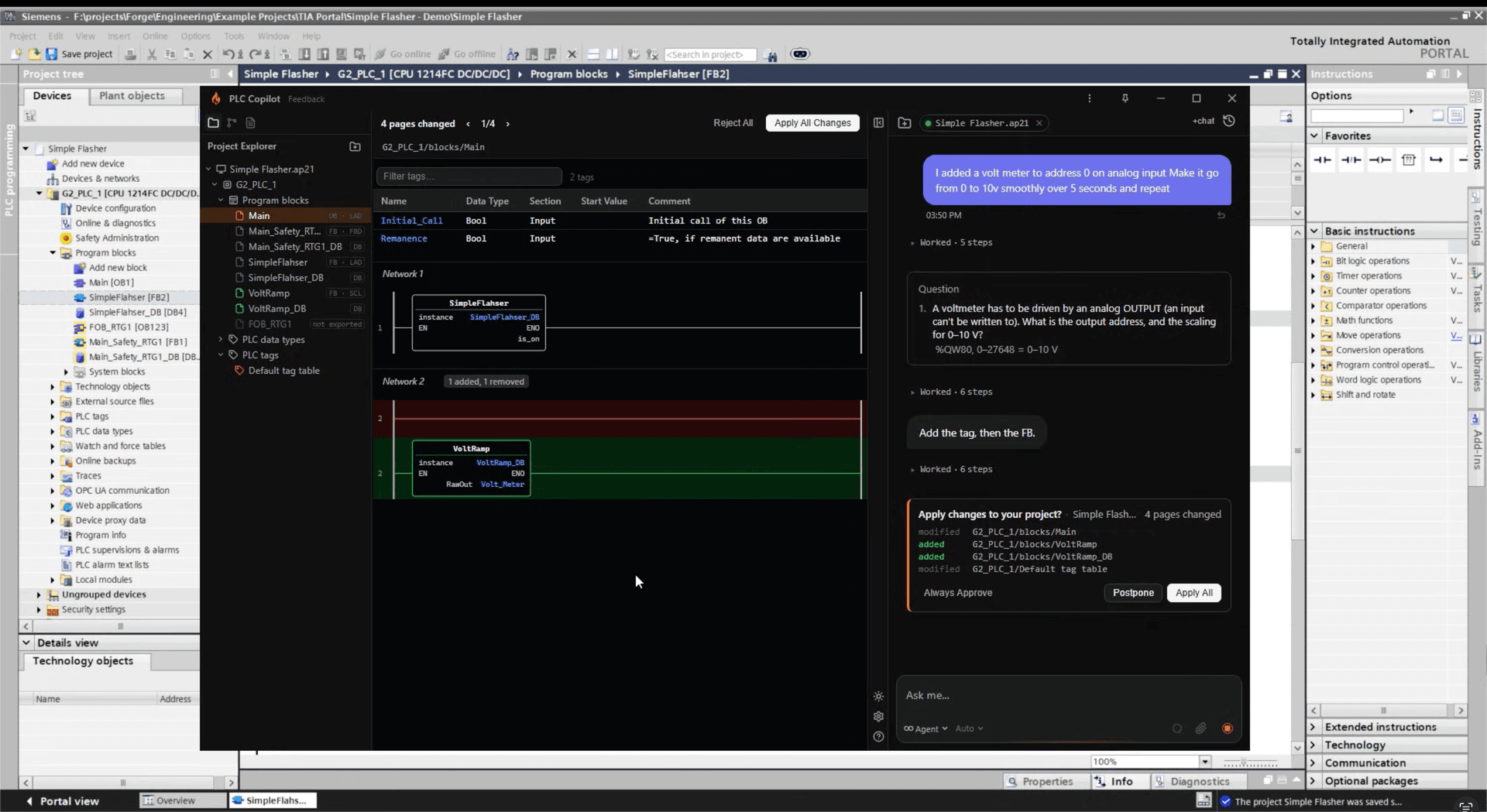
Generic AI models have a dangerous flaw: they can be incredibly convincing but entirely wrong. In the world of industrial control, a hallucinated variable or an incorrectly structured logic block isn't just a bug, it's a potential disaster. A true industrial AI assistant such as PLC Copilot provide referenced responses that are grounded in your actual project logic. This is important because as engineers, we must not blindly trust the AI's responses and we need to verify them. An agentic interface that renders the ladder logic inside the chat becomes really handy to verify the response side-by-side of the logic.
Furthermore, it needs to possess a deep, structural understanding of IEC_61131-3 languages, most importantly, Ladder Logic (LAD) and Function Block Diagram (FBD). Naturally, most generic LLM are good with text-based codes, such as Structured Control Language (SCL), but they strugle when it comes to LAD or FBD which are inherently graphical. In short, the AI should generate code you can actually trust rather than confidently hallucinating impossible instructions.
Built-In Guardrails
Safety and system integrity must always come first. Any tool interacting with your engineering environment needs strict guardrails. It should operate within a sandbox environment with strictly limited access to your PC and network. By restricting its operational boundaries, you ensure that the assistant cannot execute arbitrary commands, overwrite critical system files, or cause any unintended damage to your machine or the connected PLCs.
Consider the alternative: an unrestricted, "unsafe" AI agent operating with broad system privileges, for example Claude Code. In standard IT environments, a rogue AI action might just crash an application or delete a local file. But in an industrial automation context, the stakes are exponentially higher. An autonomous agent without strict boundaries could mistakenly initiate a logic download to a live controller, overwriting running sequences and causing catastrophic physical damage to machinery or worse.
Furthermore, an unconstrained AI with unrestricted network access could inadvertently probe sensitive OT networks, causing network storms or tripping security protocols. It could also silently alter TIA Portal configuration files or corrupt essential project backups without you even realizing it. This is why a tightly controlled, sandboxed approach isn't just a nice-to-have feature; it is an absolute necessity for any AI tool operating on the factory floor.
Human-In-The-Loop By Design
AI should act as a force multiplier, not making the decisions. The engineer must always remain the ultimate authority. An effective workflow requires a "Human-In-The-Loop" architecture, meaning the assistant can draft logic, suggest optimizations, or troubleshoot errors, but it cannot forcefully push code to the controller. You must have the ability to thoroughly review all proposed changes side-by-side with your existing logic, verify their safety, and manually approve them before they are ever applied to your project.
Local and secure
Industrial intellectual property is highly sensitive. Your proprietary machine logic, process parameters, and plant network structures are trade secrets that cannot be leaked. A robust automation assistant must prioritize keeping your data local and secure. It should ensure that your project's proprietary code and sensitive configuration data are never scraped, stored insecurely, or used to train public data models without your explicit consent. See how PLC Copilot handles project files in the data security.
Intuitive Workflow
Introducing a new tool shouldn't require you to completely change how you work. The best tools offer frictionless onboarding by integrating directly into an environment similar to what you are already used to. PLC Copilot is designed that way. When the assistant looks, feels, and operates like a natural extension of your existing setup, you spend less time fighting a new user interface and more time actually engineering. The TIA Portal quickstart walks through loading a project and asking the first question.
As the industry moves forward, working smarter is no longer optional. By choosing an assistant tailored for Siemens TIA Portal that checks all these boxes, you can accelerate your development time without ever compromising on safety, security, or the quality of your code.
Frequently asked questions
Still comparing tools? Best AI agent for PLC programming lays out specialized agents vs raw ChatGPT on real IDE workflows.